Day 2 – When Digital Reality Becomes Clear
October 11, 2025 – From echo chambers to data protection: A day of digital awakening
If day one was about connection and building trust, day two brought participants face-to-face with the complex realities of the digital world in which they live. At CCSS Tei, the atmosphere shifted from curious enthusiasm to deep concentration and heated discussions.
Digitalization in four colors: Romania, Poland, Italy, Spain
The morning began with a surprisingly revealing session. Each national team prepared a presentation about the state of digitalization in their country, and the contrasts were striking.
Young people from Poland talked about digitalization in public administration, while those from Spain spoke about free internet access. The Romanian team presented the data that formed the basis of this project: less than 20% of young Romanians verify information found online.
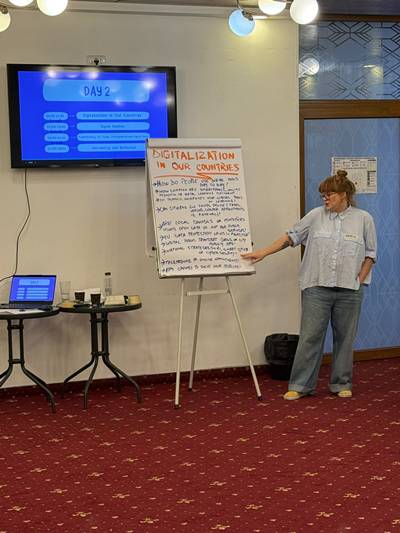 Advantages of digitalization identified by participants:
- Instant access to information and education
- Connection with people from around the world
- Remote work and freelancing opportunities
- Faster and more efficient public services
- Creative platforms for expression
Disadvantages that made everyone reflect:
- Screen dependency and digital anxiety
- Loss of face-to-face communication skills
- Fake news and manipulation
- Paradoxical social isolation in the age of connectivity
- Access differences between urban and rural areas
„I realized we have similar problems in all 4 countries,” observed Danielle from Italy. „It’s not about technology – it’s about how we use it.”
EU Regulations: When legislation becomes relevant
Andreea facilitated a session about GDPR and European data protection regulations. At first, participants seemed skeptical – „legislation” doesn’t sound exactly captivating for young people aged 18-25.
But when she asked: „How many of you have ever read the terms and conditions before clicking ‘Accept’?”, no one raised their hand.
„Now I want to show you what you’ve ACTUALLY ACCEPTED,” she continued, projecting some shocking clauses from the real terms of popular applications:
- Access to all your photos
- Permission to use your data for advertising
- The right to sell your information to third parties
„Seriously?! I agreed to that?!” exclaimed Eliza, looking shocked at her phone.
The discussion evolved toward rights: what you can ask from companies, how to delete your data, why European legislation protects you better than in other parts of the world.
„Now I understand why my grandmother always talks about ‘data security’,” said Tomek. „It’s not paranoia – it’s wisdom.”
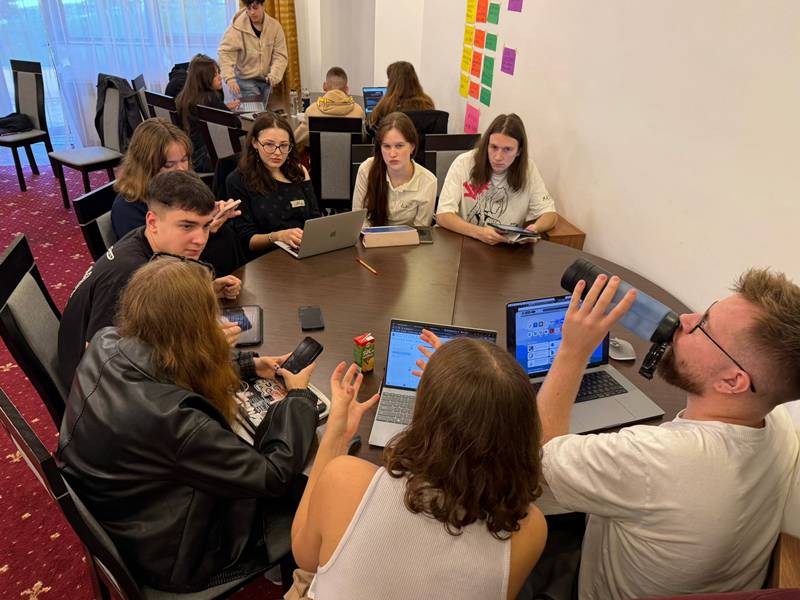
In the labyrinth of echo chambers and fake news
After the break, the atmosphere intensified. Andreea introduced the concept of „echo chamber” – algorithms that show us only what we want to see, creating our personal reality bubbles.
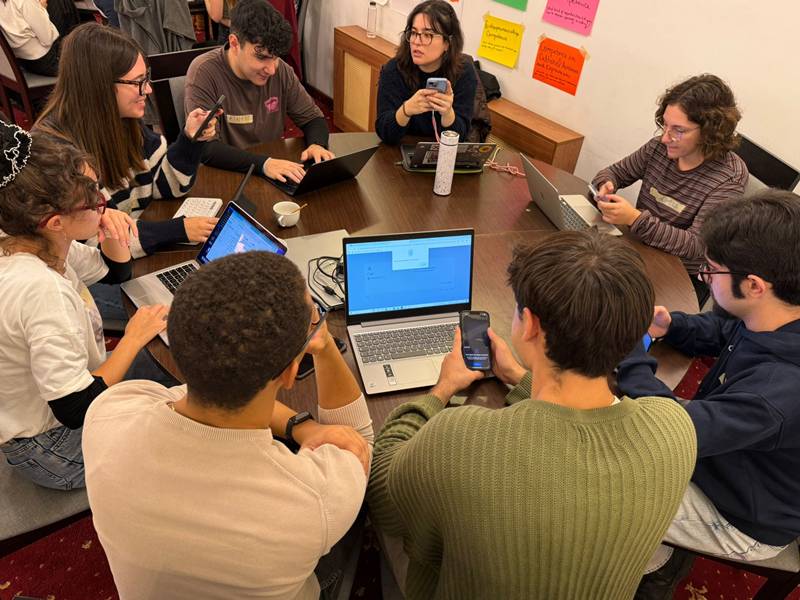
A live experiment was revealing: participants compared their TikTok and Instagram feeds. Although everyone was of similar age and had similar interests, each saw a completely different „reality.”
„I only have videos about fitness and healthy recipes,” said Sebastian from Romania. „I only have memes and gaming,” laughed Francesca. „Mine is full of political videos and climate news,” added Arianna.
„Do you see?” emphasized Andreea. „Algorithms show you what they think you want to see, but they lock you in your own bubbles. How can we understand the world if each of us lives in a different reality?”
Workshop: Detecting fake news
The facilitators prepared 10 news stories – half true, half false. Participants, in mixed teams, had 15 minutes to decide which were real.
The result? Even „digital native” young people fell into the trap 40% of the time.
„The story about ‘Study: Coffee extends life by 10 years’ seemed so real!” a participant said embarrassedly. „It even had a quoted ‘expert’ and colorful charts.”
Nicoleta taught them practical techniques: ✓ Check the source – who wrote the article? ✓ Look for the publication date – is it current? ✓ Cross-check with other trusted sources ✓ Watch out for sensational headlines (clickbait) ✓ Verify images through reverse image search ✓ Read more than just the headline!
„Before you share, take a 5-second pause and think,” was the mantra of the day.
Cyberbullying and AI: When technology becomes a weapon
After lunch, the discussion took a darker but necessary turn. The facilitators addressed cyberbullying – a topic that resonated strongly with participants.
In the safety of their circle, several young people shared personal experiences:
„I received mean comments for months on Instagram after I posted a photo. I deleted my account for 6 months,” confessed one participant, with tears in her eyes.
„A classmate from high school made a fake account and pretended to be my girlfriend, asking for photos. I only found out after months,” added another.
The group worked together to identify:
- Signs of cyberbullying
- How to report and block
- The importance of talking to someone you trust
- How to be an „upstander,” not a „bystander” (take a stand, don’t stand on the sidelines)
AI: Friend or foe?
The discussion about artificial intelligence was fascinating. AI tools were presented that can:
- Generate ultra-realistic fake photos (deepfake)
- Write texts that appear to be written by humans
- Imitate people’s voices
- Create fake news in bulk
„I saw a video of the Romanian president saying something completely false. It looked 100% real,” said Andrei, showing an example of a deepfake.
But AI isn’t only negative. Participants learned about:
- ChatGPT for learning and research (with verification!)
- AI tools for accessibility (translations, subtitles for people with hearing impairments)
- Detecting fake news with the help of AI
- Augmented creativity in art and design
„The key is to use AI as a tool, not as a source of absolute truth,” concluded Lada.
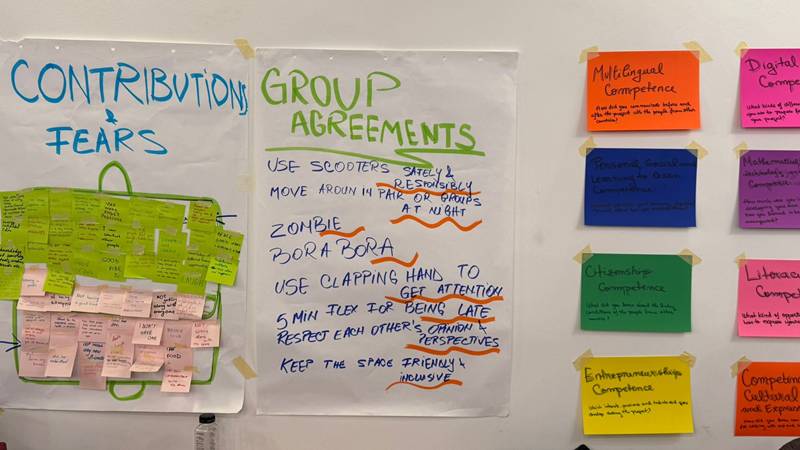
Intergenerational differences: Dialogue between generations
The last session of the day was perhaps the most moving. Participants discussed the digital gap between themselves and their parents/grandparents.
„My mother is afraid to use the banking app on her phone. She prefers to go physically to the counter,” someone shared.
„My grandfather believes that Facebook ‘steals his thoughts’ because he sees ads for things he just talked about,” someone else laughed.
But the discussion took a surprising turn when someone said: „Maybe they’re right to be cautious. We accept everything without reading.”
The group reflected: are young people too relaxed with their data, while older generations are too cautious? Or does each generation have something to learn from the other?
Together, they created a list of „intergenerational challenges”: 📱 A young person teaches a senior to use a useful application 👵 A senior teaches a young person about caution and verification 🤝 Together, they find the perfect balance
Deep reflections and full minds
The reflection session was intense. Participants had so much to process after this day.
In their reflection notebooks, participants noted:
- 3 things they will change in their digital behavior
- One thing they want to teach someone at home
- A question that remains unanswered
Evening: Conversations that continue
Even after the official program ended, discussions continued. By the lake at CCSS Tei, groups of participants stayed to talk about online privacy, how to navigate social media pressure, and how to use technology as a development tool, not as a source of validation.
„Day 2 was about awakening,” summarizes Andreea. „About opening our eyes to the realities of the digital world – the good, the bad, and the complicated. These young people are no longer just passive consumers of technology. They’re becoming critical thinkers.”
Tomorrow: We explore practical digital tools – Notion, Excel, Canva – and learn how technology can be our ally in professional development. Plus, the much-anticipated visit to the computer repair service!
Future Skills: Digital for Life continues until October 16, 2025.
Project co-funded by the European Union through the Erasmus+ programme