Day 3 of „Future Skills: Digital for Life” – From Digital Chaos to Intelligent Productivity
October 12, 2025 – When technology becomes an instrument of power, not a source of distraction
Sunday morning at CCSS Tei had a special energy. After two days of confronting the harsh realities of the digital world, participants were ready to discover how they could transform technology from an enemy into their most powerful ally. „Now that we know the dangers, let’s learn how to use the power!” announced Andreea, being met with enthusiastic reactions.
Deepening echo chambers: The experiment that changed perspectives
If on the previous day, participants discovered what echo chambers are, today they directly experienced how to overcome them.
Andreea divided the group into mixed teams and gave them an unusual challenge: „For the next 30 minutes, each of you must deliberately search for information that contradicts your personal opinions.”
Initial reactions were resistant: „Why would I do that?” asked someone confused. „But I know I’m right about climate change,” protested someone else.
„That’s exactly the problem,” smiled someone. „We all think we’re right because algorithms constantly confirm our opinions. Today we’re breaking out of our bubble.”
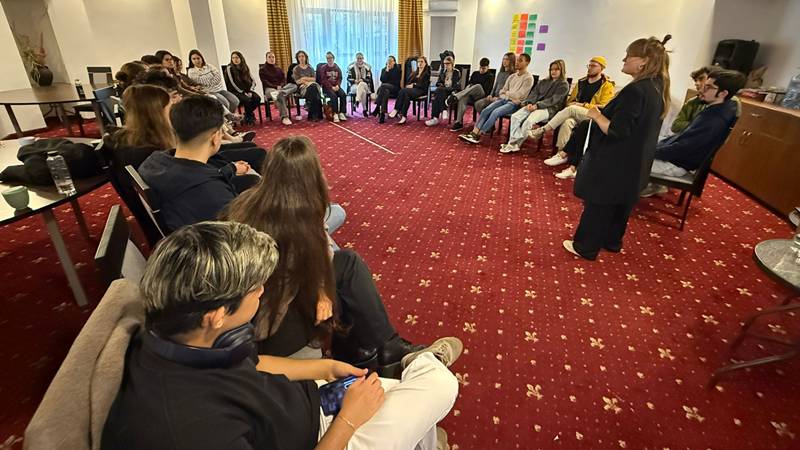
The results were revealing
After 30 minutes of „contrarian” searches, participants returned visibly affected:
„I searched for arguments against veganism, even though I’m a convinced vegan,” confessed someone from the Spanish team. „I didn’t convert, but now I understand why some people think differently. I was surprised to find valid arguments I hadn’t considered.”
„I read articles about the moderate benefits of social media,” added a participant from Poland. „I was shocked to discover serious studies showing positive aspects I didn’t know. Not everything I believed about social media is negative.”
Andreea led an in-depth debate: „We’re not asking you to change your opinions. We’re asking you to understand that reality is more complex than our feed shows us. Critical thinking means exploring all perspectives, not just the one that makes you feel good.”
Practical techniques against information bubbles
 Facilitators presented concrete tools:
Diversify sources:
- Follow news sources from different countries
- Read opinions from across the spectrum
- Explore different cultural perspectives
Check your bubbles:
- Periodically delete history to reset algorithms
- Search in incognito mode for neutral results
- Follow accounts that challenge you intellectually
Active challenge:
- Dedicate 10 minutes/day to reading something that contradicts you
- Participate in discussions with people from different backgrounds
- Ask questions, not just make statements
„I feel like a veil has fallen from my eyes,” said Eliza. „I realize now how much I was in my own bubble without knowing.”
Time Management Apps: Unexpected Allies
„The biggest irony,” began a reaction, „is that the technology that steals our time can be used to give it back.”
Participants explored practical apps they didn’t know about:
Forest – You plant a virtual tree that grows only if you don’t use your phone.
RescueTime – Automatically monitors where you spend your time online.
Freedom – Blocks websites and apps during intervals you choose.
Stay Focused/One Sec – Limits time on certain apps.
Fighting Cyberbullying: From victim to protector
The conversation took a more serious turn when they addressed cyberbullying.
„The statistic is shocking. 1 in 3 young people have experienced some form of online harassment. In this room, there are at least 9 people.”
In the safety of their circle, several participants shared painful experiences:
„I received mean comments for months on Instagram,” confessed one participant. „I deleted my account and felt isolated.”
„A classmate made a fake account pretending to be someone else,” added another.
The group learned practical strategies: ✓ Document – Screenshots with dates and context ✓ Block and report – Don’t engage in conversations ✓ Talk to someone – Don’t stay alone with the problem ✓ Be an upstander, not a bystander – Defend victims when you see harassment ✓ Use platform tools – All have anti-harassment features
„Most importantly,” emphasized Nicoleta, „it’s not your fault. Never.”
Digital Wellbeing: 8 golden rules
The group created together a „Manifesto for a healthy digital life”:
- The 20-20-20 Rule – Every 20 minutes on screen, look at something 20 meters away for 20 seconds
- No Phone Zone – Bedroom, lunch table, first/last hour of the day
- Intentional notifications – Only essentials. You control the phone, not vice versa
- Weekly screen time audit – Check statistics and adjust
- Mandatory offline activities – Minimum one per day, without screens
- Social media with purpose – Post with intention, consume with moderation
- Digital Sunset – No screen one hour before bed
- Ask yourself, „Why?” – Before opening an app: What’s my purpose now?
AI Tools & Productivity: The future is already here
After lunch break, the group’s energy was at maximum levels. Kamil and Mihai facilitated the most anticipated session: AI and productivity tools that can completely transform how you work and learn.
„Raise your hand if you’ve used ChatGPT,” asked Andreea.
Most hands went up.
„Now raise your hand if you know how to use it CORRECTLY.”
Only 3 hands remained up.
„Perfect. Today, you become experts.”
ChatGPT & Conversational AI: Beyond simple answers
Participants were amazed to discover the power of well-constructed prompts:
Weak prompt: „Tell me about the French Revolution.”
Strong prompt: „Explain the causes of the French Revolution as if you were talking to a high school student, using 3 concrete examples and comparisons with modern events. Structure the answer in: economic, social, and political causes.”
The difference in answer quality? Colossal.
„It’s like the difference between asking a teacher ‘what is this?’ and asking a specific, well-thought-out question,” observed someone.
Practical applications demonstrated live:
For students:
- Structured course summaries
- Step-by-step explanations for difficult problems
- Question generation for tests
- Brainstorming for essays (NOT complete writing!)
For jobs:
- Professional email drafts
- Report structuring
- Interview preparation
- Rapid learning of new concepts
„IMPORTANT! ChatGPT is an assistant, not a replacement for thinking. ALWAYS verify information. AI can make mistakes, can invent sources, can give convincing but false answers.”
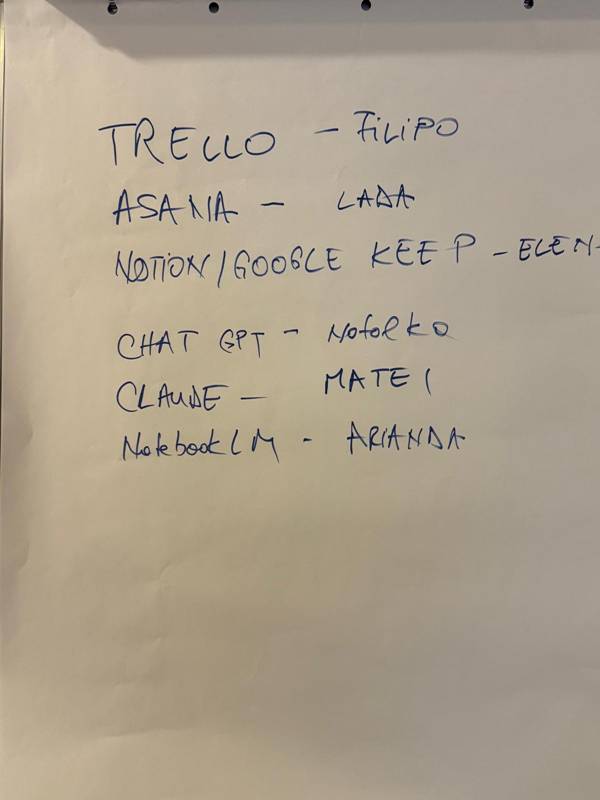
The following sessions included:
- Notion: Your operating system for life
- Trello & Asana: Simplified project management
- Google Workspace: Beyond Doc and Sheets
- Canva: Design for non-designers
Bonus Tools: The hidden treasure
In the last 15 minutes, facilitators did a rapid-fire of invaluable tools:
Grammarly – Grammar corrections in English, style, and tone. „It’s like an English teacher in your browser.”
Todoist – Smart to-do lists with recurring tasks „For people who love to check off completed tasks.”
Pocket – Save articles to read later. „No more 50 open tabs in your browser.”
Toggl – Precise time tracking. „See exactly where you spend your time. Shocking and revealing.”
Loom – Quick screen video recordings „Perfect for quick presentations or tutorials.”
Notion AI, Grammarly, Hemingway Editor – Writing assistants.”Writing becomes easier and more professional.”
LastPass/Bitwarden – Password managers: „One master password, maximum security.”
Future Skills: Digital for Life continues with spectacular transformations until October 16, 2025.
Project co-funded by the European Union through the Erasmus+ programme